Below is the link to this article.... if you scroll down to page 10 you will find a map with CO2 pipelines as of 2008.
FROM EOR TO CCS: THE EVOLVING LEGAL AND REGULATORY FRAMEWORK FOR CARBON CAPTURE AND STORAGE
Showing posts with label CO2 pipeline. Show all posts
Showing posts with label CO2 pipeline. Show all posts
Sunday, February 28, 2010
Wednesday, January 27, 2010
Indiana Take Action Today!!! Eminent Domain Bill
http://www.ibj.com/bill-would-give-co2-pipeline-firms-right-to-take-private-land/PARAMS/article/15967
Bill would give CO2 pipeline firms right to take private land
January 25, 2010
A consumer group opposing Senate Bill 115 argues the measure is yet another concession to the developer of a coal-to-methane plant proposed in Rockport, as well as to coal-fired electric utilities that may opt to transport CO2 to underground storage sites.
The measure declares that the transportation of CO2 by pipeline “is declared to be a public use and service, in the public interest, and a benefit to the
welfare of Indiana,” citing its potential to reduce carbon emissions and to promote economic development.
“Granting eminent domain to a private entity is reason enough, we think, to oppose this bill,” said Kerwin Olson, program director for Indianapolis-based Citizens Action Coalition.
The group said the measure is to benefit Indiana Gasification, which in 2006 proposed building a $1.5 billion plant in Spencer County to convert high-sulfur coal to gas. Utilities could use the gas for heating and to generate electricity.
Indiana Gasification, which planned to sell gas to Merrillville-based NIPSCO and Evansville-based Vectren, shelved plans in late-2008 after failing to reach long-term gas supply contracts with utilities, which feared such contracts could impair their long-term credit.
But last March, Gov. Mitch Daniels signed into a law a bill that would allow the Indiana Finance Authority to act as contracting agent between the gasification plant developer and the utilities buying its gas. Daniels has been a supporter of so-called clean-coal technology as an economic development tool and to protect the state’s coal and electric utility industries in the face of punitive carbon-mission regulations contemplated by Congress.
Olson said this marks the fourth year Indiana Gasification has sought various incentives from the state. The principal player in the venture, New York-based Leucadia National Corp., has sought more than $3.6 billion in federal loan guarantees from the Department of Energy for potential gasification plants.
“You’ve got a multi-billion dollar, multi-national corporation that is mandating their agenda through legislation because the business model just doesn’t support it,” Olson said of the proposed plant.
The measure could potentially grant eminent domain powers to numerous firms that plan to ship carbon dioxide trough pipelines.
Duke Energy is studying whether to inject underground the carbon dioxide to be produced at its $2.35 billion Edwardsport electric-generating plant, now under construction. Duke is looking at potential underground storage sites within 50 miles of the plant, but also has looked at piping CO2 to oil wells in southern Illinois as a way to enhance oil extraction.
In addition, Indiana is among Midwest states where Texas-based Denbury Resources is looking to run a 500-mile CO2 pipeline. It could receive carbon from power plants in the state and move it to oil fields in the Gulf of Mexico.
The sponsor of Senate Bill 115, Beverly Gard, R-Greenfield, could not be reached for comment.
Meanwhile, another measure co-sponsored by Gard is drawing fire from CAC. SB 211 would exclude the Indiana Utility Regulatory Commission from ratemaking jurisdiction over private firms that operate carbon-storage facilities or pipelines. Public utilities that hired the private firms could file ask the commission for permission to recover costs from ratepayers.
Moreover, SB 211 declares that carbon dioxide “is not considered a pollutant, a nuisance, a hazardous waste or a deleterious substance.”
CAC argues that the release of CO2 from deep-underground storage sites or from pipelines poses unknown health and environmental risks.
Bill would give CO2 pipeline firms right to take private land
January 25, 2010
A consumer group opposing Senate Bill 115 argues the measure is yet another concession to the developer of a coal-to-methane plant proposed in Rockport, as well as to coal-fired electric utilities that may opt to transport CO2 to underground storage sites.
The measure declares that the transportation of CO2 by pipeline “is declared to be a public use and service, in the public interest, and a benefit to the
welfare of Indiana,” citing its potential to reduce carbon emissions and to promote economic development.
“Granting eminent domain to a private entity is reason enough, we think, to oppose this bill,” said Kerwin Olson, program director for Indianapolis-based Citizens Action Coalition.
The group said the measure is to benefit Indiana Gasification, which in 2006 proposed building a $1.5 billion plant in Spencer County to convert high-sulfur coal to gas. Utilities could use the gas for heating and to generate electricity.
Indiana Gasification, which planned to sell gas to Merrillville-based NIPSCO and Evansville-based Vectren, shelved plans in late-2008 after failing to reach long-term gas supply contracts with utilities, which feared such contracts could impair their long-term credit.
But last March, Gov. Mitch Daniels signed into a law a bill that would allow the Indiana Finance Authority to act as contracting agent between the gasification plant developer and the utilities buying its gas. Daniels has been a supporter of so-called clean-coal technology as an economic development tool and to protect the state’s coal and electric utility industries in the face of punitive carbon-mission regulations contemplated by Congress.
Olson said this marks the fourth year Indiana Gasification has sought various incentives from the state. The principal player in the venture, New York-based Leucadia National Corp., has sought more than $3.6 billion in federal loan guarantees from the Department of Energy for potential gasification plants.
“You’ve got a multi-billion dollar, multi-national corporation that is mandating their agenda through legislation because the business model just doesn’t support it,” Olson said of the proposed plant.
The measure could potentially grant eminent domain powers to numerous firms that plan to ship carbon dioxide trough pipelines.
Duke Energy is studying whether to inject underground the carbon dioxide to be produced at its $2.35 billion Edwardsport electric-generating plant, now under construction. Duke is looking at potential underground storage sites within 50 miles of the plant, but also has looked at piping CO2 to oil wells in southern Illinois as a way to enhance oil extraction.
In addition, Indiana is among Midwest states where Texas-based Denbury Resources is looking to run a 500-mile CO2 pipeline. It could receive carbon from power plants in the state and move it to oil fields in the Gulf of Mexico.
The sponsor of Senate Bill 115, Beverly Gard, R-Greenfield, could not be reached for comment.
Meanwhile, another measure co-sponsored by Gard is drawing fire from CAC. SB 211 would exclude the Indiana Utility Regulatory Commission from ratemaking jurisdiction over private firms that operate carbon-storage facilities or pipelines. Public utilities that hired the private firms could file ask the commission for permission to recover costs from ratepayers.
Moreover, SB 211 declares that carbon dioxide “is not considered a pollutant, a nuisance, a hazardous waste or a deleterious substance.”
CAC argues that the release of CO2 from deep-underground storage sites or from pipelines poses unknown health and environmental risks.


Saturday, September 19, 2009
The Role of CO2 Enhanced Oil Recovery In Ohio’s Economy and Energy Future
http://www.pewclimate.org/docUploads/KleinhenCO2_Enhanced_Oil_Rec_rpt%208%2008_.pdf
The original article does not contain bold or highlighted text, that has been added by this blogger.
Other entries on this blog refer to EOR as the easiest way to get CO2 into a community without their opposition so they can go ahead and build their CO2 storage areas. Please read past entries to find those entries. EOR is suspect.
Note the reference to CO2 used for EOR - "Storage" = Sequestration
From the above link (2008)
Again note - "Potential CO2 sinks" -- Sinks = CO2 Sequestration (Storage)
The original article does not contain bold or highlighted text, that has been added by this blogger.
Other entries on this blog refer to EOR as the easiest way to get CO2 into a community without their opposition so they can go ahead and build their CO2 storage areas. Please read past entries to find those entries. EOR is suspect.
Note the reference to CO2 used for EOR - "Storage" = Sequestration
From the above link (2008)
I. Purpose of the study
"The Pew Center on Global Climate Change seeks to explore the potential development and use of coal gasification and carbon capture and storage (CCS) technology in Ohio. Primary benefits of developing and deploying CCS in Ohio include power generated using readily available coal while achieving substantial reductions in greenhouse gas emissions from this generation. Additional benefits include many chemical by-products, especially captured CO2 which can be used commercially for Enhanced Oil Recovery (EOR). Prior research completed by Kleinhenz & Associates for the Pew Center analyzed the economic activity factors related to coal gasification and how the location of a number of key support industries in Ohio could provide the state with a competitive advantage in this area.i This prior research did not address injection of CO2 into deep saline formations (sequestration), or storage of CO2 in association with EOR. The study also did not offer an estimate of the required pipeline network or the industries and employment affiliated with development of an Ohio CO2 market. Ohio firms have been major suppliers of the heavy equipment utilized in the oil and gas industry throughout North America. A CO2 EOR and sequestration industry would utilize similar types of heavy equipment in large volumes.
Further development of coal-gasification plants in Ohio depends upon a full understanding of the development of a CO2 market. The CO2 byproduct can be captured during the gasification process and transported via pipeline and injected in an oil or gas well to enhance recovery. With minor modifications to the process, volumes of CO2 stored through EOR can be documented. Carbon dioxide might also be sequestered (long-term) in a suitable underground reservoir containing no hydrocarbons (deep saline formation). Texas serves as a good example of a state in which the commercialization of CO2 for enhanced oil recovery as well as state regulations are well defined, while the CO2 industry in Ohio is neither defined nor commercialized. However, the Ohio House and Senate recently adopted an energy bill that would establish a regulatory framework for CO2,ii and provide credits to utilities that installed equipment for capturing carbon dioxide."
Again note - "Potential CO2 sinks" -- Sinks = CO2 Sequestration (Storage)
"Estimating the potential impact on Ohio-based industries requires a framework that includes the creation of a conceptual Ohio CO2 pipeline network. This network links proposed major sources of CO2 – such as coal gasification plants and biofuel plants – to some potential CO2 sinks with strong potential as EOR sites."
Sunday, July 26, 2009
Midwest feasibility study for possible long-term CO2 pipeline
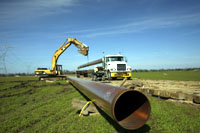
Denbury has initiated a comprehensive feasibility study of a possible long-term CO2 pipeline project which would connect proposed gasification plants in the Midwest to the Company’s existing CO2 pipeline infrastructure in Mississippi or Louisiana. The Illinois Department of Commerce and Economic Opportunity has provided financial assistance for the feasibility study for the Illinois portion of the pipeline. The feasibility study is expected to determine the most likely pipeline route, the estimated costs of constructing such a pipeline, and review regulatory, legal and permitting requirements. It is estimated that the study will be completed in the fourth quarter of 2009, following which, the Company will evaluate external market conditions, the state of financing and construction of the proposed gasification projects, and make a decision as to whether or not they will take initial steps to build such a pipeline.
Read the rest of the story here
Saturday, July 25, 2009
CO2 Pipelines - from WRI

Although CO2 pipelines are classified as hazardous, CO2 is not defined as a
hazardous substance. It is a Class L, highly volatile, nonflammable/nontoxic
material (CFRg, CFRe, Appendix B, Table 4).
CO2 pipelines are treated as hazardous and are reviewed as high-risk hazardous pipelines when they have a diameter greater than 457mm(18 in) or when they pass through High-Consequence Areas.
States certified to regulate intrastate pipelines are: Alabama, Arizona, California, Louisiana, Maryland, Minnesota, Mississippi, New York, Oklahoma, New Mexico, Texas, Virginia,Washington, and West Virginia.
49 CFR § 195.2 defines low-stress pipeline as a hazardous liquid pipeline that is
operated in its entirety at a stress level of 20 percent or less of the specified minimum-yield strength of the pipeline (CFRf).
49 CFR § 195.2 defines rural area as an area outside the limits of any incorporated or unincorporated city, town, village, or any other designated residential or commercial area, such as a subdivision, a business or shopping center, or community development. The rural areas are considered to be the nonenvironmentally sensitive areas (CFRf).
An easement is a limited perpetual interest in land that allows the pipeline owner
to construct, operate, and maintain a pipeline across the land. An easement does
not grant an unlimited entitlement to use the right of way. The rights of the
easement owner are set out in the easement agreement.
Eminent domain is the power of government to take private land for public use.
Under current law there is no federal eminent domain power granted for the
construction of CO2 pipelines. A number of states, however, do allow the use of
eminent domain for CO2 pipeline construction under certain conditions.
The information above comes from the link below -
From WRI - World Resources Institute CCS Guidelines - this information is found on page 52
Tuesday, May 26, 2009
A REGIONAL CONCEPT FOR A CO2 PIPELINE NETWORK
https://www.purdue.edu/discoverypark/energy/pdfs/cctr/presentations/Lambeck-CCTR-June08.pdf
Mr. Klaus Lambeck
Public Utilities Company of Ohio is a member of the National Coal Council - link below.
http://www.nationalcoalcouncil.org/
Mr. Klaus Lambeck
Public Utilities Company of Ohio is a member of the National Coal Council - link below.
http://www.nationalcoalcouncil.org/
Subscribe to:
Posts (Atom)