Friday, July 31, 2009

House Hearing On Carbon Sequestration & Drinking Water Protection


Click here to be taken to this article

July 2008

Jul 24: The House Energy & Commerce Committee, Subcommittee on Environment and Hazardous Materials, Chaired by Representative Gene Green (D-TX), held a hearing entitled, Carbon Sequestration: Risks, Opportunities, and Protection of Drinking Water. Witnesses testifying at the hearing included Benjamin Grumbles, Assistant Administrator Office of Water for U.S. EPA, and representatives from: Energy Resources Team U.S. Geological Survey National Center; Strategic Center for Coal of U.S. Department of Energy (DOE); Oil and Gas Commission; American Water Works Association (AWWA); Bureau of Economic Geology, University of Texas at Austin; Environmental Defense Fund (EDF); and the Coal Utilization Research Council.

In opening remarks, full Committee Chairman John Dingell (D-MI) said, "Water is critical to growth and economic development in many areas of the country, and will become even more so in future years. In pursuing the goal of carbon capture and storage, a system must be in place that protects the quality of drinking water sources and assures the public that this is a safe way to proceed. Approximately one week ago EPA released proposed regulations under the Safe Drinking Water Act designed to achieve these goals [
See WIMS 7/15/08]. I look forward to EPA’s testimony and the views of our other witnesses on the adequacy of the proposed regulations and any gaps that remain to be addressed.

EPA testified that geologic sequestration associated with Carbon Capture and Storage (CCS) is a promising technology that provides an innovative solution for reducing emissions of (CO2) to the atmosphere, while safeguarding our country’s underground sources of drinking water. EPA said the UIC program is focused on protecting public health by preventing injection wells from contaminating underground sources of drinking water. EPA’s proposed regulations build on more than 35 years of experience in the UIC program of safely injecting fluids, either liquid, gas or slurry, including CO2, into the subsurface. Annually, billions of gallons of fluids are injected underground through wells authorized under State and Federal UIC Programs. This includes approximately 35 million tons of carbon dioxide that are injected for the purposes of enhancing oil and gas recovery.

The buoyancy of CO2, its potential corrosivity when in water, the potential presence of impurities in captured CO2, its mobility within subsurface formations, and the large injection volumes anticipated at full scale deployment, have all been considered in requirements tailored to the new practice of injecting CO2 for long-term storage. EPA’s proposal would create a new well type -- a Class VI UIC well. EPA said, "We believe we have developed a framework that will ensure safe injection in the present and safe storage in the future."

USGS testified that Section 711 of the Energy Independence and Security Act (P.L. 110-140), enacted into law in December 2007, authorized the Secretary of the Interior, acting through the Director of the USGS, to develop an assessment methodology and conduct a national assessment of geological storage capacity in collaboration with the Secretary of Energy, the Administrator of EPA, and the State geological surveys. USGS will collaborate with DOE to incorporate the results of the assessment into future revisions of the DOE “Carbon Sequestration Atlas of the United States and Canada”. The cumulative advances from these earlier USGS studies and DOE-funded activities provide a basis for developing a methodology to assess the national capacity to store CO2 and understand the potential impacts of large-scale deployment of geologic sequestration.

DOE testified that the 2006 Carbon Sequestration Atlas contains information on major CO2 emission point sources, geologic formations with sequestration potential, and some terrestrial ecosystems that offer the potential for enhanced carbon uptake – all referenced to their geographic location to enable analysis of CO2 sources and storage sites. An interactive version of the Atlas is publicly available through the National Carbon Explorer (NATCARB) website [See below]. DOE is funding a network of seven Regional Carbon Sequestration Partnerships to help develop technology, infrastructure, and best practices/protocols for implementing CO2 sequestration in different geologies of the Nation. This approach includes engaging local organizations and citizens to contribute expertise, experience, and perspectives that represent their concerns and goals.

AWWA testified, "Our overarching concern regarding geologic carbon sequestration is the potential contamination of underground sources of drinking water (USDW) from such activities and the potential for other unintended, and possibly harmful, consequences. AWWA is particularly concerned about the potential for contamination of sole source aquifers and suggests that these aquifers be provided with special protective measures. An aquifer receives the designation of “sole source aquifer” if it is located in an area where there are few or no alternative sources to the ground water resource, and where if contamination occurred, using an alternative source would be extremely expensive. AWWA urges caution on the implementation of large-scale, commercial geologic carbon sequestration, as little data are available regarding the potential effects of this technology on drinking water resources. . . AWWA recommends that commercial-scale carbon sequestration not be deployed until the results of the large-scale Department of Energy pilot projects have been received and reviewed. . . "

AWWA also draws attention to the significant issue of long-term liability resolved. EPA’s proposed geologic carbon sequestration rule cannot address financial responsibility of the sequestration site after the formal period of post-injection site care has ended (default of 50 year length). AWWA says Congress must develop legislation that will address the issue of who has to assume financial responsibility of the sequestration site after the site closure requirements have been fulfilled and anticipates a means by which drinking water utilities could recover any costs incurred as a result contamination.

Wednesday, July 29, 2009

Public Interest Groups Oppose Carbon Capture Scam


Unproven technology, Ridiculous Risk, Exorbitant Cost
Oppose industry-driven plans for carbon capture and sequestration (CCS) to keep COAL burning. Read this article

The time to stop these projects is BEFORE COAL, and its friends, enter your community!

It's time to find alternatives - every dime spent on CCS is a dime spent on COAL and NOT Renewable Energy.
Not only does CCS keep the coal industry going, it requires up to 40% MORE ENERGY - MORE COAL !


Citizens Against CO2 Sequestration has taken a stand in our community to oppose Carbon Capture and Sequestration.

Our Community is opposing one of the 7 DOE large-scale CO2 sequestration demonstrations (experiments) targeted for our community - the MRCSP Phase III project. This grassroots movement of concerned citizens understands the risks and finds them unacceptable for our community - and yours.

700+ Opposition Yard Signs are up - with more on the way!

Darke County is an agriculturally strong community, ranking #1 and #2 in most areas. Our Farmers' Union has taken a stand to oppose CCS! (Thank you Darke County farmers!)

Protect health, safety and environment - Take A Stand AGAINST CCS

Fighting a CCS (Carbon Capture and Sequestration) project in your community?
Contact us.

StopExperimentalCO2Projects@yahoo.com


DO MORE

Click Here to Access the Sierra Club Web Site

To Sign the Petition and Add Your Name to Oppose Coal

America needs more clean energy jobs and less pollution--and President Obama's EPA already has the power to act. Sign their petition to your Senators asking them to urge President Obama to create rules that regulate coal ash, mercury, soot and carbon pollution.


Evaluating Geological CO2 Sequestion Sites (Permanent Storage)


"This report describes a screening and ranking framework (SRF) developed to evaluate
potential geologic carbon dioxide (CO2) storage sites on the basis of health, safety, and environmental (HSE) risk arising from possible CO2 leakage. The approach assumes that HSE risk due to CO2 leakage is dependent on three basic characteristics of a geologic CO2 storage site: (1) the potential for primary containment by the target formation, (2) the potential for secondary containment if the primary formation leaks, and (3) the potential for attenuation and dispersion of leaking CO2 if the primary formation leaks and secondary containment fails. The framework is implemented in a spreadsheet in which users enter numerical scores representing expert opinions or general information available from published materials, along with estimates of uncertainty to evaluate the three basic characteristics in order to screen and rank candidate sites. Application of the framework to the Rio Visa Gas Field, Ventura Oil Field, and Mammoth Mountain demonstrates the approach."

The full report can be accessed here

CO2 Sequestration - Does NOT work


Ike Solem says:

Read the full story here


The reality is not quite as rosy as it looks. This same issue arose in 2007, when the nuclear industry tried to force $50 billion in loan guarantees through. Historically, nuclear and coal and oil have received giant federal subsidies in the form of loan guarantees, tax breaks, and direct subsidies via zero-oversight federal contracting deals. Despite popular pressure to roll back these subsidies and promises by politicians to do so, they largely remain intact – only gross expansions of these subsidies have been defeated – and according to reports, the $2 billion for the FutureGen “clean coal” project remains in the bill.

That’s $2 billion for one generation plant using an apparently failed technology. (The U.S. federal budget for ALL solar photovoltaic research is about 1/20th of that, $100 million) The technology is secret and proprietary and is controlled by a financial consortium of private coal interests (i.e. Southern, Peabody, BHPBilliton, etc.) and military government contractors (Battelle, the primary organizer). There are no published papers on the technology, which they refuse to talk about because it is proprietary. Try asking the technical advisers about it:

http://www.futuregenalliance.org/alliance/advisors.stm

Battelle is the world’s largest private research corporation, who manages five National Labs for the Department of Energy and plays the leading role in the U.S. biological warfare program, as well as in many other areas of military and commercial R&D. They are the proprietary controllers of FutureGen technology, and they’ve never published anything on it either. Despite the public financing of the project, Battelle insists that only “non-proprietary performance data” can be released, whatever that means. Fraud is the most likely story here.

The fact of the matter is that carbon sequestration-based coal combustion does not work, and will never work, on simple physical arguments. There’s also no prototype – for example, a car that drives down the road while capturing all CO2 emissions in the trunk. Try sticking a potato in the tailpipe – that’s what all CO2 sequestration involves – massive power losses. It’s likely that if you could design a coal plant that captured 90% of its CO2 emissions, it would only produce 10% of the power (per ton of coal) that a dirty modern coal plant does. There’s no way around it, especially if the coal is loaded up with sulfur and mercury and arsenic, as is typical.

What we don’t see is $2 billion to build an integrated wind-solar power system with backup biomass generations in some city as a test case. They are doing this in Germany – but not here. The reason for that is that the Democratic politicians from the coal states are dedicated supporters of the coal industry, and yes, that does include Obama and Dick Durbin, as well as Jeff Bingaman.

The last thing the coal industry wants to see is a city anywhere in the U.S. that operates entirely on renewable power – but it can be done, and it would be the perfect example. $2 billion would be a good initial investment – but there would be howls from the fossil fuel industry, that’s for sure – and they own Congress, more or less. You don’t see oil executives and coal executives being hauled before Congress the way the auto and finance executives were, do you? And no one is asking financiers why they are investing their bailout money in fossil fuels and not in renewables, either. (Bloomberg reported that Morgan Stanley and Citigroup were buying oil up and storing it in supertankers – a way to drive up the price, or to reserve oil for when prices rise – and these banks are also invested in fossil fuels, thanks to the repeal of Glass-Steagall banking rules c.1999 – and that’s why those rules were put in place – banks should not be able to loan their customer’s money to firms that they hold shares in, period).

I would put the celebrations on hold – this stimulus package is the equivalent of a band aid on a shark bite. There’s a whole lot of work to be done still, and the issues are very complicated. This was not a defeat for coal interests – they lost nothing, and even gained a little something. It would be a lot easier if the press would honestly cover this story, but they haven’t.

Monday, July 27, 2009

German Grassroots Opposition Movement with local political support


Many citizens, on the other hand, are worried about the effects of the project. "If a CO2 storage site is built here, the tourists will stay away," says Werner Asmus. He is the unsalaried mayor of the community of Wallsbüll and the spokesman for a citizens' initiative that already claims to have recruited 2,500 supporters. Local politicians are calling it a "real grassroots movement." In addition to Green Party members, conservative Christian Democratic mayors of local towns are calling upon their citizens to refuse to allow the employees of electric utilities to set foot on their property. In the Weser River region, entire counties have blocked RWE's exploration activities.


Many fear that the storage sites will not be leak-proof. Besides, they are seen as a green fig leaf, the sole purpose of which is to extend the operating life of coal-fired power plants, thereby delaying the development of renewable energy sources.

http://www.spiegel.de/international/germany/0,1518,632620,00.html

Sunday, July 26, 2009

Midwest feasibility study for possible long-term CO2 pipeline


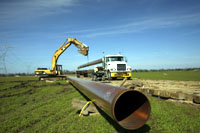
Denbury has initiated a comprehensive feasibility study of a possible long-term CO2 pipeline project which would connect proposed gasification plants in the Midwest to the Company’s existing CO2 pipeline infrastructure in Mississippi or Louisiana. The Illinois Department of Commerce and Economic Opportunity has provided financial assistance for the feasibility study for the Illinois portion of the pipeline. The feasibility study is expected to determine the most likely pipeline route, the estimated costs of constructing such a pipeline, and review regulatory, legal and permitting requirements. It is estimated that the study will be completed in the fourth quarter of 2009, following which, the Company will evaluate external market conditions, the state of financing and construction of the proposed gasification projects, and make a decision as to whether or not they will take initial steps to build such a pipeline.

Read the rest of the story here

Citizens Against CO2 Sequestration - Parade


We were invited to ride on Doug Harmon's Coldwell Banker float - and we never miss the opportunity to show up in our hot yellow-green shirts and promote our cause - STOPPING CO2 Sequestration in Darke County - while some of our crew sold yard signs, Tshirt, buttons and window clings!


Photo by Jason Aslinger (www.darkejournal.com)

CO2 Sequestration Poll for Darke County on DarkeJournal.com


Thank you, Darke Journal for conducting this poll - and many thanks to our residents who voted in the poll against the proposed CO2 sequestration project in Greenville, Ohio.


As you will recall, The Daily Advocate, did a poll prior to our Call to Action Meeting the end of June.... results below


Posted by Picasa


Click here to be taken to the poll


PLEASE NOTE: This poll was conducted prior to the past month’s concerted effort to educate and inform the public regarding the proposed sequestration.


***


Published July 1, 2009


Recently, The Daily Advocate sent out a Reader’s Poll to online newsletter subscribers about the proposed carbon sequestration project in Greenville. The poll consisted of 10 questions based on concerns the newspaper was receiving from local residents.


The poll was sent out to 2,268 subscribers and received 161 responses.

Of the 161 responses, 73 percent felt that there should be a public vote on the proposed project.


“How do we stop this project? The people of the county should decide what happens,” wrote on respondent.


“A public vote is the best way to go. Why? Because the co2 sequestration affects all our properties, all our jobs, and all of our community not just a select few government leaders who ‘should’ be representing the county,” wrote another.


“This project should be voted on by the public.We the public and our children will be the ones who will have to live with the after effects for years and years to come,” said another.


Many others (40 percent) felt that the project needed local government approval to move forward.


Concerns were other big issues. Fifty-nine percent said that local farmers should be concerned about the impact of the project.


And, 36 percent said that the project would impact their property’s value. Fifty percent said that the project was dangerous.


“I do not feel this project is in the best interest of OUR community! It’s an experiment with too many risk factors, especially when it’s messing with our fresh water supply,” states one individual.


“This is a threat to our lifestyle and our community and me and my family are strongly opposed to anything to do with this project. Battelle can take this project back to the city with them,” another person strongly stated.


The majority did not feel that the project was a good idea for the community (59 percent) or that it would make our community more ‘green’ (50 percent).


Respondents strongly agreed that they needed more information about the project (55 percent) and that Battelle, the company proposing the project, did not seem very committed to the well being of the

community (44 percent). Thirty-eight percent of respondents said that the project should provide a reward to the community for taking the risk.


Read more comments from the respondents on the Web site at
http://www.advocate360.org

Saturday, July 25, 2009

CCS Guidelines from WRI


These excerpts come from this link

Principles for Meaningful Community Engagement

(1) Identify stakeholders early. X
(2) Define the intended outcomes of community engagement. X
(3) Determine whether to inform, consult, or negotiate. X
(4) Engage communities throughout the project cycle. X X X X X
(5) Allow communities to raise grievances. X X X X
(6) Promote internal and external monitoring. X X X X

SOUR C E : HE R B E R T SON 2 0 0 8


(note - allowing communities to raise grievances - interesting that there is no conflict resolution mentioned or considered)


Water Use
"Power plants, with or without CO2 capture, use large amounts of water."

"Note that water use for PC power plants more than doubles with the addition
of capture equipment."

"The impacts of increased water use associated with CO2 capture are related to the increased need for system cooling. As an alternative to wet cooling, facilities could use dry cooling technologies. There is a trade off between energy use and water use when dry cooling is employed. As a facility reduces water use, it increases energy use, which creates an additional energy penalty."
(Note- since the ethanol plant has been operating, we have had water issues and many wells go dry in the area close to it and now this calls for even MORE water, our most precious resource)


Seismic Activity (Page 74)

" The presence of seismically active faults does NOT exclude a site from either holding CO2 or being considered for storage, although a strong demonstration must be made that there would
be no risk of leakage resulting from seismic activity. There are many places in the world where large volumes of buoyant fluids (e.g., oil, gas, and CO2) are trapped indefinitely in the presence
of seismic activity, including California, Wyoming, Alaska, Turkey, Western Australia, Papua New Guinea, Indonesia, and Iran. After the injection of almost 9,000 metric tons of CO2 in the
Nagaoka CCS demonstration, operations were disrupted by the Mid-Niigata Chuetsu 6.0-magnitude earthquake. Following careful evaluation, it was determined that the wells, the
reservoir, and the facility were intact and undamaged, and injection resumed (RIITE 2008)."


" Many aspects of a fault affect its ability to trap CO2 at a site. These include the geometry of the fault, its complexity, the orientation of the fault relative to regional stresses, the amount
and distribution of fault goug e, and the occurrence of either elevated or reduced pressure nearby (Yielding 1997). In some cases, it is relatively straightforward to obtain key pieces of
information that can be used to understand the potential risks presented by a fault or network of faults. Recently, Chiaramonte et al. (2007) gathered information to estimate the potential for
faults within one oil field to transmit CO2. In their calculation, one fault had a very low chance of becoming transmissive, and would require injections well above reasonable operational
pressures to act as a leakage conduit. In contrast, another fault network in a different part of the field would act as a conduit for CO2 in the presence of even a small injection. If this were an
operational site, the southern part of the field would be a good zone of storage, while the northern part would not because of the possibility for transmissive faults at operational pressures."

"This example highlights the need for careful site characterization in selection and the importance of high-quality data. The presence of large, active faults should not necessarily preclude prospective sites from selection as storage sites. Rather, the complex nature of faults in and associated with potential injection sites must be characterized, considered, and managed as part of a risk assessment and MMV plan. Hazard identification should focus on faults that could be transmissive within the injection reservoir or confining zone and expected project footprint, as faults only represent a substantial hazard if they can transmit large volumes of CO2."

(Note - the people who plan and conduct these risky experiments do not live in these communities nor do they have plans to live in them - In our community residents have been told that once CO2 injection enters the picture their homeowner's insurance will not cover man-made earthquakes.

CO2 Pipelines - from WRI


Although CO2 pipelines are classified as hazardous, CO2 is not defined as a
hazardous substance. It is a Class L, highly volatile, nonflammable/nontoxic
material (CFRg, CFRe, Appendix B, Table 4).

CO2 pipelines are treated as hazardous and are reviewed as high-risk hazardous pipelines when they have a diameter greater than 457mm(18 in) or when they pass through High-Consequence Areas.

States certified to regulate intrastate pipelines are: Alabama, Arizona, California, Louisiana, Maryland, Minnesota, Mississippi, New York, Oklahoma, New Mexico, Texas, Virginia,Washington, and West Virginia.

49 CFR § 195.2 defines low-stress pipeline as a hazardous liquid pipeline that is
operated in its entirety at a stress level of 20 percent or less of the specified minimum-yield strength of the pipeline (CFRf).

49 CFR § 195.2 defines rural area as an area outside the limits of any incorporated or unincorporated city, town, village, or any other designated residential or commercial area, such as a subdivision, a business or shopping center, or community development. The rural areas are considered to be the nonenvironmentally sensitive areas (CFRf).

An easement is a limited perpetual interest in land that allows the pipeline owner
to construct, operate, and maintain a pipeline across the land. An easement does
not grant an unlimited entitlement to use the right of way. The rights of the
easement owner are set out in the easement agreement.

Eminent domain is the power of government to take private land for public use.
Under current law there is no federal eminent domain power granted for the
construction of CO2 pipelines. A number of states, however, do allow the use of
eminent domain for CO2 pipeline construction under certain conditions.

The information above comes from the link below -

From WRI - World Resources Institute CCS Guidelines - this information is found on page 52